The Glow-worm, the natural history of Lampyris noctiluca. By John Tyler, Published by Pelagic. ISBN 978-1-78427-644-7
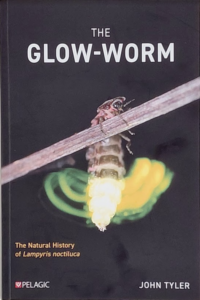
At last a delightful book on the familiar Glow-worm that is increasingly less found out and about in villages and the countryside at large. The book has been written by professional entomologist and conservationist John Tyler who trained at Oxford. It is a very good book, thorough, comprehensive and an interesting read for anyone interested in the living world who cares about the slow, almost inevitable, demise of species like this. We are treated to the ancestry of Glow-worms from those stuck in liquid amber some 100m years ago, to the what citizen scientists can find when they look around – he encourages us to list sightings on iRecord. There is a ‘Lesser Glow-worm’, less often seen, of these two firefly species in the UK (not Ireland) whereas there are 20 species in Italy. This species is ‘the most widespread firefly in Eurasia, perhaps the world’ and it has a huge range within 100km of the Arctic Circle as the most northerly firefly’. The chapters on how the Glow-worm survives in the environment and how it feeds are fascinating. As the female is flightless colonisation is limited to the crawling larvae and the flying males. Isolation of populations is now a big issue in today’s world, where diminishing populations reduce the gene flow. The author lists six reasons creating decline, habitat destruction, habitat change, habitat fragmentation, chemical pollution, light pollution and climate change. The best habitat that Glow-worms seem to prefer, says John Tyler are ‘patchworks of trees, shrubs and grassland’ managed too, perhaps by grazing or browsing by human initiative such as by horses, cattle or sheep, and in the ‘wild’ by rabbits. Management should be attained by trying to create a mosaic of scrub and coppice. Photographs are provided of typical habitats where Glow-worms are found, and these include old quarries, grassland and railway lines which he says ‘these linear habitats are good for dispersal.’ Not forgetting that they have a ‘fondness for waterside habitats.’ In my own experience I have found few Glow-worms and they have been along ancient lanes (yes adjacent to water) in my own garden and in a railway sidings – all habitats influenced by man. The details provided on how Glow-worms are so successful as predators and carnivores is perhaps not explained better in any other book but here. The cocktail of neurotoxins that these beetle larvae inject into their snail and slug prey works wonders and they are able to disable and devour snails that are 30 times heavier. Over 30 species of snail are attacked and eaten, so no shortage of prey, and they get into the snail’s shell using their extendable head and a pair of fierce jaws. Overall this is an excellent book that explains all that is known about this enigmatic species that has lit our enthusiasm for the natural world. The colour illustrations are helpful for identification of habitat, species and sexes and there is a comprehensive references and index. John Feltwell.