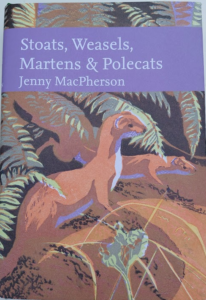
Stoats, Weasels, Martens & Polecats: A Natural History of British & Irish Small Mustelids. Number 149 in The New Naturalist Library, by Jenny MacPherson. 2024. 375pp. ISBN 978-0-00-833493-2. £65 Hardback with Dust Cover.
Written by the go-to expert on Pine Martens, Dr Jenny MacPherson gained her PhD at Royal Holloway College, London where she fell under the influence of leading mammalogist Pat Morris who encouraged her to write this book. She had earlier seen ‘the most beautiful animal’ she had ever seen in Scotland when badger-watching when a weasel appeared. That provided the original spark. (I too gained a PhD from Holloway, and was similarly encouraged by Pat, but in a different direction.) This is a hefty tome which goes to extraordinary lengths to discuss everything every scientist seems to know about these small mustelids; some such as weasels and stoat have complete global distribution east to west across the whole of the northern hemisphere. Impressive conquerors. Only interrupted, and expanded, by their transport to New Zealand where they changed the balance of nature unintentionally. The book does not include details on the larger mustelid cousins Badger and Otter which are adequately dealt with in other books. Nor of the Wolverine, so these ferocious mustelid mammals remind me of the seriously blood-curdling ferocious Tasmanian Devil and the Quolls, which are carnivorous marsupials from down under. The northern hemisphere Wolverine is not described as this book is all about the smaller mustelids. And a great book it is though. Incidentally, the only Wolverine in Sussex is a pelt in Rudyard Kipling’s study; so at least Kipling was up to speed on one impressive mustelid, which maybe it tempered his writing. There is a lot in this book. It is arranged in thirteen chapters from all the information about the origin of weasels (including a ‘Meet the Weasels’ chapter) right through to mythology and mysteries to do with mustelids; mustelids seem to have got everywhere in texts from cave paintings to the present. Fascinating details have been revealed. I am not sure one would not like to meet some mustelids face to face (well mammalogists excepted), as they always have business to attend to, as highly-honed killers. They have been killed relentlessly for their ermine and tails (a nice photographic chapter on mustelids in portraiture from Leonardo to the royal’s penchant for ermine) and they have been hung and tallied on gamekeepers gibbets to the verge of extinction. The winter whiteness in coat colour is well described and illustrated and the differences evolved in Ireland well explained. The book is to the very high standard expected of any NNL series, and is generously illustrated in colour and black and white, with scientific and general indexes and references. This is a worthy coveted tome which will be ferociously gobbled up by students, naturalists and general public who will want to know everything about this lively group of successful exciting mustelids which have carved out a perfect niche in nature. Let them thrive. The book is a masterpiece. John Feltwell