Insect Flight, An Insect-Eye View of Flight Behaviour in the Wild. By John H. Brackenbury. London, London, Pelagic Publishing. 168pp ISBN 9781784276263
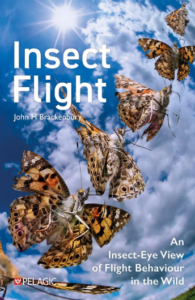
The author is a retired zoologist from University of Cambridge and Fellow of the Royal Photographic Society, so he presents here many of his collected fruits of his photographic journey using high speed cameras. This is not the first of his books on capturing flight, he has published ‘Up Up and Away’, and ‘In the Blink of an Eye’, which also feature ‘flight cascades’ of an insect taking off, such as is found on the cover of this book. These sequential images or ‘reconstructed flight sequences’ used to be hard to create but increasingly modern cameras such as Nikons and Olympus do the job. Brackenbury does not have a section of cameras but from the range of images it looks like several types have been used. His subjects are mostly drawn from European fauna, as he says he has photographed a ‘a mere fraction’ from the million of insect species worldwide. The book gives an insight into the very biodiverse world of insects, from somersaulting Alder flies and Caddisflies to grasshoppers leaping and airborne dragonflies. He describes the mechanics of leaping, jumping and flying, and this reminds me of Dame Miriam Rothschild’s leaping fleas taking off with the power of 140Gs and thirty times the power of a Saturn rocket blasting off; pity fleas were not covered. The way that butterflies fly is however covered in demonstrating the way in which the large wing area interestingly distorts through the air as it flies. The images capture what the naked eye cannot see, so this presentation of insects in flight is useful for a better understanding of their biodiverse and successful life on earth. The mechanics of upstroke and downstrokes in insects are described by way of diagrams of photographs, even showing the sequence of a bird taking off in one full sequence. There are seven chapters ranging from How Wings Work, Butterfly Flight and Male Flight Behaviour, as well as Mating flight. There is some interesting behavioural and ecological observations in these chapters. We also see how hibernating wasps carefully fold their wings perfectly so that they are undamaged when they come out of hibernation from wood piles or leaf litter months later. Lepidopterists will enjoy the close-up ‘frozen moving‘ images of various white species, Painted Ladys, Peacocks and Red Admirals, all flying in their colourful meadows or grassland setting; many shots enhanced with sunburst star filters against blue skies. Entomologists with a more wider interest will like the range of beetles, true-flies and crickets. There are few books on the subject of insect flight, but Roger Camp’s (2003) book on Butterflies in Flight – which opens out as a concertinaed pull out a few metres long, comes to mind, but is different. The Brackenbury book fits nicely in the Pegasus series as an up to date introduction to the flightly world of insects that has made them so successful in the world. There is an general index and a QR code to the author’s YouTube channel.