Category Archives: Conservation

Solar arrays – what’s the problem?

                       Solar arrays – what’s the problem?

Villagers, including ramblers, are increasingly expressing concern about solar arrays in the community. Here are the ecology issues.

But first, here is my background: I was the ecologist on 60 of the 1000 large scale solar farms in England in Wales. Locally in East Sussex I was the ecologist for the Pashley Farm (Ninfield) solar farm.

Solar Ecology Facts:

  1. All these large solar farms are becoming nature reserves in their own right.
  2. This is because they were only granted planning permission on the basis of addressing ecological planning Conditions.
  3. The Conditions were for enhancements such as ponds, beetle banks, reptile and amphibian shelters, bird and bat boxes, badger swing gates, log piles, hedgehog homes, new hedgerows, buffer zones, wildflower meadows.
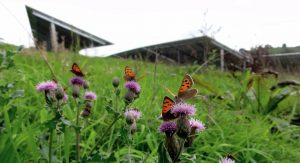
  4. Note: Even without enhancements the biodiversity goes up from year one, as the solar farms are all fenced and secure and wildlife moves in naturally.
  5. Solar farms / arrays should only go on poor grade soil land, or brownfield, not Grade 1 or 2 (so as not to take away any food production). And never in protected areas such as AONBs, SSSIs or nature reserves (e.g. such as the one proposed inside the Hastings Country Park nature reserve). There are advices and codes (see bibliography).
  6. There is little adverse environmental impact from solars, as they above the ground on posts, and in many cases grazed by sheep below, so farming continues as normal.  Soil conservation is assured.
  7. There appears to be no adverse environmental impact on wildlife (birds) from ‘glare’ (see refs).
  8. Planning permission for solars is granted for 25 years in most cases (some exceptions).
  9. There is usually a Condition to restore the site back to what it was – ‘to revert it to its original condition’ (typically oilseed rape, or winter wheat); it will be a conservation nightmare as it will have become biodiverse through the conditioned enhancements.
  10. Thus solar farms are nature reserves – all 1000 of them. Fenced and secure, where wildlife thrives naturally and has been deliberately encouraged.

Access – Rambling

Solar farms are mostly not open access as they are on private land.  With the loss of the Feed in Tariff (FIT), many local authorities are maximizing their own council land, realising they could provide community electricity and sell it. Similarly, villagers are also creating their own community solar arrays. Where footpaths and bridlepaths are beside, or through, a solar farm, then this can always be accommodated in the design – creating a safe and fenced-off walkway. Remember all solar farms are dangerous ‘power stations’.  See aerial Google.maps for walkways through solar farms as in the Fareham area of Hampshire. Ecological interpretive boards were provided there to help observe flora and fauna.

Monitoring planning applications – what you can do

There is no ecological objection to solar arrays on private land – they can only be good for biodiversity especially with enhancements.

Pros:

i) clean, sustainable energy;

ii) land protected from other development for 25 years – a benefit! Solars are temporary.

Cons: eyesore??  See below – participate in the planning process

When consulting planning applications for solar arrays then it is best to:

  • Ensure that the site has a Phase 1 Habitats Survey to determine any protected species present e.g. badgers, newts.
  • If protected species present, what avoidance or mitigation is applied?
  • Ensure that application design plan incorporates each enhancement.
  • Ask for a bund to restrict visual intrusion where necessary.
  • Ask for a screening hedgerow (native species – oak, holly, field maple, hornbeam).  (great opportunity here for insisting on filling gaps in hedgerows – good for wildlife corridors).
  • Remind LPAs to have a generous buffer (e.g.10m) between arrays and protected areas such as Ancient woodland (local policies often apply), and instigate wildlife enhancements such as in 3) above.
  • Protect all single trees on site – they can be accommodated on most solar farms,
  • Ensure badger gates are incorporated where badgers are present (see 1,2).
  • Ensure developer adheres to best practices (see Biblio).
  • Does the connection to the grid go through badger setts (can be up to 1km long), or through or past protected habitats etc.
  • Ask for an Interpretive board to explain what wildlife there is to be seen.

Publications on solar arrays and biodiversity by John Feltwell (2013-2015)

Feltwell, J. 2013a.  Are photovoltaic solar arrays an influencing factor in avian mortality? The Newsletter of The Kent Field Club. February 2013. Number 77, p.18-27.

No impact on birds

Feltwell, J. 2013b Solar Farms and Biodiversity. Guest blog on Solar Power Portal. 16  September 2013.     http://www.solarpowerportal.co.uk/guest_blog/solar_farms_and_biodiversity_2356

                    Solar farms boost biodiversity, even make nature reserves.

Feltwell, J. 2013c Résumé of solar farms in England and Wales.  Briefing given at National Trust roundtable, 17 September 2013. http://www.solar-trade.org.uk/solarFarms.cfm

Feltwell, J. 2013d. Solar farms for bumblebees. Buzzword, The Bumblebee Conservation Trust’s  Members Newsletter. November 2013. Issue 23, p.13-14.

                   Solar farms excellent for bumblebees and other insects

Feltwell, J. 2013e. Biodiversity on solar farms – building tomorrow’s solar farms.  Solar Business  Focus UK. Volume 10 – 2013. 6-7.

                    Solar farms boost biodiversity, even make nature reserves. Solar are the new ‘fallow’

Feltwell, J. 2013f.  A comparative biodiversity study of a working solar farm and a wheat field in West  Sussex, July- November 2013. (Unpublished Report, dated 7 December 2013).

Increased biodiversity on a solar farm compared to an organic wheat field

Feltwell, J. 2014a. Solar farms: gain or grain? Solar Business Focus UK. Volume 11 – 2014. p.40-41.

           Solar farms do not take more than 0.14% away from the UK’s agricultural crops

Feltwell, J. 2014b Observations on the effects of photovoltaic solar panels on invertebrates at Ebbsfleet Farm, Sandwich, Kent 2010-2012. The Newsletter of The Kent Field Club. Number 79.

February 2014. p.4-17.  No impact on invertebrates  (there are 32,000 terrestrial inverts in Britain)

  1. E. Parker and L. Greene (with Feltwell, J. 2014c as co-contributor) BRE (2014) Biodiversity Guidance for Solar Developments. Eds. G. E. Parker and L. Greene. 9pp.

                      Essential reading for all developers and planners….  Introduction of the BMP  (Biodiversity Management Plan).

Feltwell, J. 2014d, reviewed by John Arthur LLP. Solar farms and eco-law. E-Law, Issue 84 (September-October) pp.27-30. An On-line publication by UK Environmental Law Association.       

                       An up to date résumé of solar farms and UK and EU law

Feltwell, J. BLOG on solar farms and biodiversity http://www.britishrenewables.com/landowners/blog/

13 Nov 2014 Thoughts on Biodiversity,    15 Dec 2014 Sustainable Solar Farms,     15 Jan 2015 NPPF and Biodiversity


Bibliography

BRE (2014) Agricultural Good Practice Guidance for Solar Farms. Ed J Scurlock, http://isea.co.com/news-docs/Agricultural-   Good-Practice-Guidance-for-Solar-Farms.pdf

(retrieved 28 Oct 2021)

Evidence review of the impact of solar farms on birds, bats and general ecology 2016 (NEER012)   file:///C:/Users/John/Downloads/NEER012%20Evidence%20review%20of%20the%20impact%20of%20solar%20farms%20on%20birds,%20bats%20and%20general%20ecology%202016.pdf (retrieved 28 Oct 2021)

       Dr John Feltwell, A Wildlife Matters Flier  dated 29 Oct 2021  http://wildlifematters.com   – free to circulate

Death’s Head H/Moth … 2021

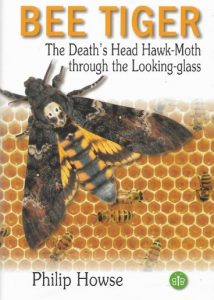
Howse, P.  2021, Bee Tiger: The Death’s Head Hawk-Moth through the Looking-glass. Brambleby Books. pp119. ISBN  978-1-908241-62-7  9-781908 24 1627  £13.99


There have been precious few books on a single moth, with the exception of perhaps the Silk moth, Bombyx mori or one of the moon moths or emperors or some of the glamorous day-flying moths. This is not so much an entomological treatise on the Death’s head hawk-moth than a comprehensive discourse on skulls, bones and all interpretations of these patterns and messages as we may see them;  it is all in the sub-title, ‘through the looking glass’. Mimicry, which is the author’s passion, and nature’s gift, is full of visual interpretation of the dynamic living world and thus subject to vagaries in our understanding. There is a tendency to anthropomorphosise. And so it is with this hawk-moth. It is a large lumbering moth which has evolved to be a honey thief within honeybee colonies. For a large lumbering moth it must have an acute sense of smell to search out and find honeybee colonies, and as for its large size, it does need this to go deep in a hive and plunder the goods. It may of course be too big for bats to handle, as bats weigh less.  Unusually for hawk-moths the death’s head has a very stubby proboscis which it pierces the capped brood and feeds unmolested by the bees. Philip Howse, describes how the morphology of the moth, and its sounds, mimic the piping of the queen bee and it may thus sooth the behaviour of the colony.  Of the bright colour of this moth, the contrasting yellows and black we are told mimic the warming colours of wasps and hornets – more for the daytime predators, birds and reptiles than bees.  And, as for the scary death’s head, this is also for daytime predators – especially if seen from in front, rather than as we conventionally view a moth as settled or set. The classic medusa head of ancient Rome and Pompeii are invoked, especially with hair entwined with snakes. Photos of heads and skulls are shown, including Picasso’s ‘In Voluptate Mors’. Philip Howse is a poet and he publishes a few of his lines as well as many others, and cites quotations from a host of others including Homer, Faust, Proust, Jung, Darwin and more recently Miriam Rothschild who also was enthralled by the moth.  The book is relatively short with nine blank pages at the back (printing problem?) and there is a bibliography, index and glossary of 28 colour plates.   There are nine chapters, three of which are linked, the honeybees’ tale, the bat’s tale and the bird’s tale – all expressing how mechanisms have evolved in these groups over millions of years to feast and forage. The author goes to extraordinary lengths to describe the colour vision of birds and then at the end of the chapter to show how birds might view the moth. The same for the bat’s tale chapter, and exposé of the bat’s capabilities in detecting prey on the wing, all backed up with up to date technical research and discoveries.  With an exciting cover, and a good in-depth read around the subjects, this book will appeal to entomologists, naturalists and members of the general public. The author is Professor Emeritus in Biological Sciences at the University of Southampton and is the author of a number of general natural history books.


Much Ado About Mothing

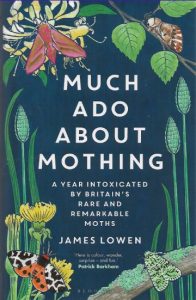
Much Ado About Mothing; a year intoxicated by Britain’s rare and remarkable Moths. 2021. By James Lowen. London, Bloomsbury Wildlife. £18.99. 384pp.  ISBN 978-1-4729-6697-1   9 781472 966971

.

We have already had a butterfly enthusiast run around Britain in a year to shoot all the butterfly species, in the name of Patrick Barkham in his ‘The Butterfly Isles’; he reviews this book on the cover as ‘Here is colour, wonder, surprise – and fun’.  Now we have James Lowen setting himself the target of chasing rare and remarkable moths around the islands, from Cornwall to the Cairngorms. Not that he is chasing all the moths – an impossible task with about 40 times more moths than butterflies.

Lowen was initially inspired to all things moths by a poplar hawk-moth which he had to hand. Most people are enthralled by the beauty and evolution of animals, and essentially this is what this book is about, it celebrates the enthusiasm that one man has for moths. James is completely moth-centric. He exudes moth enthusiasm the way other people pursue particular wildflowers, fungi, bryophytes or even tardigrades.

James is an all-round naturalist, whose grass roots were in Yorkshire which set his seed for the living world, and he has explored South America and the poles; he writes for various papers and has a number of books to his name.  His conversion to moths has been recent and profound, not least encouraged by the enthusiasm of his daughter, Maya who figures in the book, especially in the eight pages of colour photographs in the middle of book which figure 15 species of moth, but which mostly shows venues, equipment and techniques. Oh for more illustrations for a group with 2,500 species.

There are 20 chapters starting with winter-spring and ending in autumn. Although only four chapter headings give a clue about the subjects (Hawk-Moths, Kentish Glory, Clearwings and Blues – read Clifton Nonpareil), the rest are very discursive and story-like, on how a site visit was formulated, with advice from whom, how they got there, what it was like on arrival, the type of habitat and finally the exaltation of finding the target.

The book is well researched and his sorties to various far flung habitats is usually to link up with regional moth experts to explore last known locales and pabula. Local contacts from wildlife groups and from Butterfly Conservation (which also conserves moths) and RSPB (yes moths too) and national projects such as ‘Back from the Brink’ are often the source of his targets.  He has included classic lep stories and research involving Miriam Rothschild and Bernard Kettlewell and waxes lyrical about the new arrival the horse-chestnut micro. Where would he be without his treacle ropes, actinics and other entomological paraphernalia.

His writing is florid and descriptive to an intense or even excessive level; his descriptions of moths are flowery and romantic, whether it is the Old Lady, Scotch burnet, Netted carpet, Crimson underwings, Merveille du Jour or hawk-moths. In his quest to find moths James clocked up 14,000 miles over 258 days and visited 139 locations across 27 counties of equivalent.  A job well done.  But only touching the surface of moth biodiversity.

The book is ideal for general readership. A good read for moth-ers without the scientific clutter. The book will be of interest to naturalists, entomologists and lepidopterists and as a book on moths it is unique and unrivalled. There is an index, a bibliography and list of acknowledgements which runs to four pages. The cover is exciting and colourful. It’s a good book to hand, especially with the colourful and exciting cover.

From the flyleaf blurb it says…’no animal may be better placed to inspire the environmentalists of the future.’  Good luck with that then!  Moths will still continue to have a bad press (as most are brown, hairy and scary to the general public), even though they are more biodiverse than butterflies and in many cases more colourful than butterflies such as the day-fliers which James covers in his travels.  Let’s hope this book has started a revival in their fortunes.


‘Gone’ by Michael Blencowe


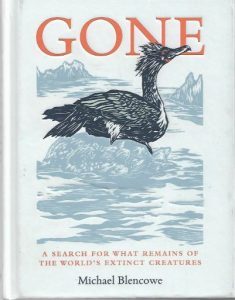
‘Gone – A Search for what remains of the world’s extinct creatures’ by Michael Blencowe. ISBN 978-0-7112-5675-0  9-780711 256750. Ivy Press, Leaping Hare Press, 2021.   192pp

Focusing on just eleven animals, the author provides an interesting narrative on species that have now disappeared, some rather quickly since being discovered ,such is the impact of man.

The author, from the Sussex Wildlife Trust, describes the Booth Museum in Brighton where the tower clock has stopped at three minutes to midnight – a reminder of the overall global decline of nature and the little time to find a fix.

There is another Sussex connection, since the chapter on the dodo is enlivened with the author’s encounter with the world’s expert on dodos who lives in Battle, Ralfe Whistler who has various dodo artefacts.

This selection of doomed animals is just the tip of the 413 species of animals, plants and fungi lost in Great Britain in the last 200 years (quoted on page 176). This does not seem enough loss compared to the overall publicised position. The UK government admits (2021) that 14 out of 42 biodiversity indicators show a long term decline of habitats and species.

Michael has visited many other museums around the world, for instance to see the whole skeleton of the now extinct Stella’s sea cow in the Helsinki (Finland) Natural History Museum. These were huge blubbery mammals weighing several tons, floated on the surface and ate kelp. It took just 27 years between discovery to their butchered extinction.

Blencowe has visited the formidable collections of Lord Rothschild at Tring to see the two specimens of the Spectacled Cormorant, and the Smithsonian Museum, and brings the book right up to date with new discoveries in Japan on recently found bones.

Blencowe has a very discursive style of writing and puts notable events in the text as a reminder of what was happening in the world at the time of more recent extinctions. The book is incredibly well researched with every timeline explored resulting in the ultimate demise of the species. It is a revelation of man’s effect on wildlife.  There is much fascinating detail on expeditions, who ran them, what they doing, and which discoveries were made. The book will appeal to a wide readership, older children and adults, and as a definitive account of these ‘gone’ animals. It is a good book just to pick up and read a single species chapter. Excellent for a train journey.

The book is dedicated to Michael’s long-lived pet tortoise (Tootles) which leads the reader to all about the Pinta Island Tortoise (Galapagos) and the inevitable demise of famous ‘Lonesome George’ on 24 June 2012.

The book includes a world map showing where the selected species lived (Galapagos, California, Iceland, Reunion, Japan, and three in New Zealand, and two in Russia) and the positions of twelve museums (four in southern England, three in New Zealand), to visit. Surely, a bee-line will be needed in Brighton to visit the Booth Museum.

The pages are interspersed with delightful colour prints in various muted colour shades of various greens and browns by Jade Thery,  all nicely displayed on the page. There is a Further Reading section. Altogether the book is a very satisfactory good read and good to have in any natural history library.

April-May Wildflowers

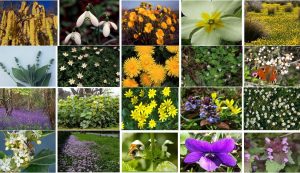
TWENTY  COMMON NATIVE WILDFLOWERS of East Sussex

Hazel (Corylus avellana), Snowdrop (Galathanus nivalis), Colt’s foot (Tussilago farfara), Primrose (Primula veris), Buttercup (Ranunculus sp), Dog’s Mercury (Mercuralis perennis), Wood Anemone (Anemone nemoralis), Dandelion (Taraxacum officinalis), Wood Sorrel (Rumex acetosa), Sloe or Blackthorn (Prunus spinosa) (with Peacock butterfly) Bluebells (Hyacinthoides non-scriptus), Yellow Achangel (Lamiastrum galeobdolon), Lesser Celandine (Ranunculus ficaria), Bugle (Ajuga reptans), Daisy (Bellis perennis), Holly (Ilex aquifolium) flowers (with honeybee), Milkmaids or Lady’s Smock (Cardamines pratensis), White Deadnettle (Lamium album) (with bumblebee), Dog Violet (Viola ), Red Deadnettle (Lamium purpureum).


Uplands & Birds 2020

Uplands and Birds by Ian Newton. No. 142 in The New Naturalist Library. London, William Collins. 2020. 598pp.

The author is a seasoned NNL writer, having already penned four volumes, Finches (1972), Bird Migration (2010), Bird Populations (2013) and Farmland and Birds (2017), and guess what from those titles, he is ‘an ornithologist and applied scientist, and a leading expert on bird ecology and migration, specialising in finches, waterfowl and birds of prey’ as the flyleaf states. He started work with NERC in 1967. This must be some sort of record for NNL writers. This is a big book only beaten by ‘Farmland and Birds’ (630pp). There are 17 chapters, mostly on birds – the title could have been reduced to ‘Upland Birds’ but the intriguing chapter on ‘Sward-makers’ is all about how deer, sheep and goats have formed the hillsides, and there are chapters on hill-farming of the valleys and uplands (the ‘Lower Fields’, and the ‘Open Hills’) and an excellent chapter on Native Woodlands from the post-glacial period to the present day. Whilst maps show the uplands down the west of Britain, we are told that peat bogs cover one tenth of the land in Britain and that they are increasingly appreciated as carbon stores.

Topically, there are two chapters about grouse on raptors, management and gamekeepers, and another chapter on rewilding. He explains there are now about 300 moors, of which managed grouse moors cover less than one-fifth of the British uplands, mostly in Scotland, but also in England, and now, none in Wales. Management of grouse moors comes down to five actions, 1) rotational patchy sward burning, 2) drainage of damp peat bogs (ceasing), 3) contolling of vertebrate predators of grouse, including ‘foxes, mustelids, corvids and, illegally, also raptors..’ (Newton has written elsewhere extensively on raptors in uplands) 4)  treatment with anthelmintic drugs to reduce infection by the strongyle worm Trichostrongylus tenuis, and 5) treatment of sheep with acaricide. Newton thinks it would be sad to see grouse moors disappear if there is no compromise from both sides; they are are actively working to find a way to manage grouse moors without killing raptors.

Newton prefers to use the term ‘rewilding’ though he says that some splitters like to think of rewilding as ‘an attempt to replicate what might have existed in the Mesolithic’ – if we really knew, and ‘wilding’ which is ‘just letting existing nature take its course’. The most cited rewilding experiment is the Knepp Estate in West Sussex (1,400ha), where they take the view it is wilding, as in their book ‘Wilding’ (reviewed here in 2020). However, as Ian Newton explains this is just a tiny fraction of what is already in progress with examples such as 60,000ha in Speyside, 29,334ha at the National Trust’s Mar Estate and 23,000ha in Glen Tromie.

It is good to see that The Flows are mentioned in detail – under ‘birds displaced by forestry’, and how many of the botanically rich peat bogs were sadly lost to tax breaks, but Newton explains that RSPB removed 2,600ha of conifers and a further 2,000ha have been approved for clearance. He states that ‘nearly one-fifth of the British uplands are currently under conifer plantations’. By replacing peat bogs with forestry eventually increases species numbers and overall bird densities increase with forest age he says – but it can be painfully slow – and he admits that ‘afforestation of former open land leads to the replacement of one bird community with another’ – yes botanically also!  In his ‘Farming and Birds’ book he has a section on insect declines, which sets the scene, somewhat, for the change in avifauna populations seen today.

The book is well illustrated with colour photographs of upland habitats, management of uplands and fauna of the uplands. There are subject and species indexes and a comprehensive table on the ‘Breeding Habitats and Winter Distributions of Upland Birds’ according to the different habitats regions. The book is ideal for libraries, naturalists and ornithologists, and it is a welcome addition to the NNL. It is a comprehensive assessment of birds in the uplands,all supported by peer-reviewed evidence.  What will be the author’s sixth NNL book?


Bill Gates’s climate book 2021

How to Avoid a Climate Disaster, the solutions we have and the breakthroughs we need. 2021.  By Bill Gates. Allen Lane, an imprint of Penguin Books. 256pp. ISBN 978-0-241-44830-4 and 9 780241448304.


The author, if you didn’t know is a ‘technologist, business leader and philanthropist’ as he describes himself. He is also co-founder of Microsoft. The author is more well known in the world of computers, than his books, previous titles being ‘The Road Ahead’ and ‘Business @ the Speed of Thought’, both with co-authors. But this is now his own book written through Covid 19 and as up to date as one could expect. With Climate Change he says we should remember just two things,51 billion and zero – 51 billion tons being the amount of carbon we add to the atmosphere each year, and zero is what we should aim for.  The chapters have simple titles such as How we plug in, How we make things, How we grow things and How we keep cool and Stay warm. In a sense it is really a simple book with everything set out in a basic formula. It is best not to cherry-pick chapters to read, as it really is meant to be read from the beginning, and his ‘Green Premium’ is a thread that runs through the book. Once you understand the Green Premium you can then cherry-pick, and have a fascinating read. The Green Premium is the difference between for instance fossil fuel prices and the higher priced advanced biofuel prices. That is the extra you have to pay for ‘greener’ products.  For each chapter there is this simple formula: how we got there, why these materials are so problematic for the climate: then the Green Premium is calculated to reducing emissions, how emissions are driven down to make the various materials (steel, electricity, or electric vehicles (EVs) without producing carbon.

Here is a man who has spoken to all the experts and listened to all their advice and is written from a unique perspective. He is also fortunate to be rich enough to pursue his engineering passions through his Bill and Melinda Gates Foundation.  Gates has a fascination with engineering. He particularly likes cement, and waxes lyrical about the longest floating bridge in the world in Seattle, being made of cement with hollows. It seems he investigates everything. We learn that he likes to visit power plants for fun. He repeatedly pours money into new start-ups on the basis that they might perform and do good in the world, often loosing millions. During this Covid 19 pandemic he, via the Melinda and the Gates Foundation committed more than $445 million in grants to fighting the disease, and ‘hundreds of millions more’ to get vaccines.  He has also put $1billion into approaches to offset emissions to zero, all part of his plan to reduce his own personal footprint. He acknowledges that he has big houses and jets around the world, and his foundation was singled out by The Guardian for his effect on the world, and he has more than offset these shortcomings.  In 2015 he encouraged 24 heads of state who formed ‘Mission Innovation’ which now funds $4.6 million annually on clean energy research.

Gates comes out is with simple sentences that sum up world figures, such as on Offshore Wind, that it it is only 0.4% of the world’s energy output in 2019, and that it is only 1/32,000th  of the contribution to America electricity. And on storage batteries, he comes up with a hypothetical scenario if Toyko’s electricity fails from an extreme weather event, how many batteries would be needed to keep the lights on for three days – 14 million, or that is more than the world’s storage capacity in a decade. So we have not got there yet with batteries. There is a lot on solar power, that the cost of panels came down 10 times between 2010 and 2020. The existing old grid is often the problem to moving electricity, for instance to achieve California goal of 60% renewable by 2030, and New York’s goal of 70% green energy cannot do it without enhancing the grid. He loves his calculations and puzzles. Which is the cheapest in the US, a gallon of milk, a gallon of orange-juice or a gallon of gasoline?

The book has a 1950s feel to it, with well read pages and soft and slightly coloured paper – it feels like it should come with the pleasant smell of an old and familiar book – but it is a FSC of paper mix from ‘responsible sources’. There is an index and references to sources for each chapter (and eight blank pages at the back, surely not for notes?). There are quite a few graphs and pie charts and a few black and white photographs, but not overpowered with too many images, and no colour photographs (which it does not need).

Strangely, the book is a cross between a basic textbook on climate change and a ‘Which? guide to which EV car to buy, or boiler, or which energy source to buy, air source or ground source, with a New Scientist article thrown in. The basic worldwide facts are presented from one of the best informed person on the planet. The book is very  US-Centric throughout especially in figures (but bracketed-up with European equivalents by editors) but that is not a detraction; it is of interest how this philanthropist ticks. The book is very readable and is highly recommended for youngsters aged 12 up to adults.


Pollinators & Pollination 2021

Pollinators & Pollination. Nature and Society. By Jeff Ollerton. Published by Pelagic Publishing. ISBN 978-1-78427-228-9.  2021. 286pp. £24.25

As the blurb states Prof Jeff Ollerton is ‘one of the world’s leading pollination ecologists’ who works at the University of Northampton. Most of his 30-year’s research is poured into this major work and it has plenty of graphs as an evidence base for his ideas and theories. He states that he has pitched the book ‘at a very broad audience, and is intended to be comprehensible to anyone with an interest in science and the environment.’ He has succeeded admirably in this aim, and it covers an area not explored by other bee experts whose work is discussed. This is the first time I have seen a blanket acknowledgement for all his academic contacts rather than mentioning bee experts by name. This is not just about bees and pollination – though it may seem that way as Apis mellifera is a major pollinator – it is about all pollinators, birds, reptiles, mammals and invertebrates. There are an estimated 350,000 terrestrial vertebrates and invertebrate species that move pollen, for the estimated 352,000 species of flowering plant: so flowering plants are well catered for and co-evolution is patently evident.  Invertebrates are the commonest pollinators: the estimated number of species, from the largest to the smallest as listed, are Lepidoptera (141,500 species), through Coleoptera (77,300), Hymenoptera (70,000), Diptera (55,000) and Thysanoptera (1,500 species).The book has 14 chapters ranging from ‘To be a flower’ to ‘Agricultural Perspectives’ to ‘New Bees on the Block’ – mostly about the Tree Bumblebee and The Ivy Bee, and the 17 species of bee, wasp and true-flies that have turned up in Britain since 2000. A lot of the collation has been by BWARS.  He even has a chapter on ‘The politics of pollination.’ There is a section on neonics in which Ollerton reminds us they are chemically similar to naturally occuring nicotine, which used to be used a long time ago. He debates all sides of the issue, but unfortunately just missed the latest UK authorisation of neonics prior to publication. In reviewing the literature he shows that some recent research ‘strongly implicated as a likely driver of those declines.’  It is good to see that Buglife-The Invertebrate Conservation Trust is mentioned, as well as the National Pollinator Strategy. As the author states ‘I have tried to provide a personal, state-of-the-art overview of what pollinators are, where they are to be found, how they contribute to the pollination of both wild and agricultural plants, supporting the wild ecosystems…’ etc.  There are just a few colour photographs dotted about the book, but it really offers extended essays on topics rather than pretty photos that can be found in a host of other bee books.   The References run to 32pp and there is an index.

ESCC’s Enviro.. Strategy 2020 & SLNP Natural Capital,2019

ESCC’s Environment Strategy; At pace & at scale’ (2020)

The ESCC Environment Strategy was published in two parts in 2020, the Strategy (16pp) and the Appendix (38pp) dated March 2020 and June 2020 respectively.[1]  It replaces the first Environment Strategy for East Sussex adopted in 2011. A lot of rhetoric, national dilemmas, and UK concerns are repeated throughout this document. Turning to East Sussex, it states that 470 species that are globally threatened in the county, or in rapid decline. The Strategy is updated to be in line with the 25 year Environment Plan (2018) and Parliament’s declaration of Climate Emergency in 2019.

The Strategy’s vision is ‘protect and enhance our natural and built environment for current and future generations and tackle and adapt to climate change.’  That is a familiar mantra that goes back decades and is invested in UK law. ‘conserve and enhance’. The Strategy is disappointing in what it does not cover. There are no references to nature conservation or soil conservation, SSSIs, BAPs, Ancient Woodland, Wood-pasture, or surprisingly nothing major on biodiversity. It acknowledges the impact on woodlands in East Sussex (which has more than most counties), especially the impact on associated woodland habitats ‘the loss of valued areas for recreation.’

Natural Capital is mentioned, and is comprehensively dealt with in the Appendix; whilst everyone is nervously awaiting the result of the Environment Bill in its final deliberation on net gain in which way to jump.  Nationally, it is interesting to note that OFWAT are aiming to ‘protect and improve at least 6,000km of waterways, and protect and improve 1,800ha of protected nature conservation sites by 2025. One hopes this will trickle down to East Sussex. This will clearly be a rolling strategy for East Sussex, but the document as presented, does not have a functioning feedback email address, and the Team Manager is aware of the various typos and states that further information on nature conservation is to be found in the Sussex Local Nature Partnership document ‘Natural Capital Investment Strategy for Sussex 2019-2024.’  At present, it is a disappointing document.

[1] East Sussex County Council, 2020. Is in two parts i) ‘The Environment Strategy’, dated March 2020 (16pp) and ‘The Technical Appendix to the Environment Strategy’, dated June 2020 (38pp).

https://www.eastsussex.gov.uk/media/15587/east-sussex-environment-strategy-2020.pdf

https://www.eastsussex.gov.uk/media/15589/east-sussex-environment-strategy-2020-technical-appendix.pdf  (accessed 01 December 2020).

Note: The above ESCC Environment Strategy 2020 relies upon the following publication for nature conservation issues, facts and figures.

Natural Capital Investment Strategy for Sussex, 2019-2024. Sussex Local Nature Partnership, December 2019. Final Version. (adopted by Sussex LNP October 2019).  73pp.    

Twenty-four Sussex Local Nature Partners (SLNP) participated in drawing together this 73pp compilation of Natural Capital Investment Strategy in Sussex. Both East and West Sussex are lumped together, and obvious nature conservation groups have been involved such as Sussex Wildlife Trust, CPRE, CLA, EA, NE, NFU, SDNPA, ESCC (but no LPAs). This reviewer has been told (Dec 2020) by the on-line administrator of The ESCC Environment Strategy 2020 that it relies upon this document for all the information on nature conservation that is not within the Environment Strategy. It is just over a year since this document was produced (adopted by SLNP October 2019), but it still has not published the assets that it is still counting up. Sussex’s assets are its habitat types, and this document lists these which it classifies as ‘natural capital asset types.’  The assets it is relying on are on page14, which lists, for instance four types of Ancient Woodland.

However, it does not list ‘Wood-pasture & Parkland BAPs’ which are Priority BAPs – a serious error. These are associated woodland habitats of ancient woodland recognised by Natural England. There is a risk that the eventual quantum of assets will only be based on some of the statutorily protected areas such as NNRs, SSSIs, SACs, SPAs and Ramsars whilst other important habitats, protected by other statutory instruments will not be represented in the overall audit.

The omission is replicated in Table 2a (p.68) ‘Terrestrial Assets’, where at risk habitats are highlighted in red.  They do note that woodland is under risk of ‘loss of valued areas for recreation’. There is not a word about ‘Wood Pasture and Parkland BAPs’.  It is as if the law embedded in NERC (2006) – a statutory act – is not recognised.

The report has produced various useful maps across Sussex (too small to expand) and an intriquing ‘Woodland Heathmap’. This shows that there are three areas across the Sussexes, one in the east, one in the north central area of Sussex and one in the east. This is where there are:

existing woodland concentrations in Sussex,’ In these areas what is proposed is ‘In terms of biodiversity benefit, new woodland plantings regeneration in the areas of high woodland concentration can be used very beneficially to expand and connect woodland fragments and thus strengthen woodland ecological works.’

 Alarmingly, the document states that ‘At time of writing this strategy, no ‘valuations’ have yet been published for the natural capital of Sussex.’ (http://sussexlnp.org.uk/what-is-natural-capital/).  This is a concerning relevation. Without any valuations there can be no informed or considered view, so the report is not supported by any evidence.  Valuations are awaited to inform the strategy in Sussex, whilst the climate emergency continues.

There are some inherent downfalls in calculating nett gain for the nature conservation, as RSPB points out that removing an ancient woodland to make way for conifers that do a good job in carbon sequestration, plus providing BMX tracts of recreational value, may improve the economic value, but the irreplaceable loss of ancient woodland cannot be quantified. (RSPB (2017) Accounting for Nature: A natural capital account of the RSPB’s estate in England.). Not that anyone is proposing to remove ancient woodland in Sussex, but in other parts of the country the removal of ancient woodland for HS2 has in part been mitigated by replanting.

So, nature conservation in both the Sussex counties is currently held in the balance, whilst the parameters for calculating the assets that the counties are decided. SLNP have not taken Sussex a step forward in knowing what to protect, only advising of the concern that the climate emergency has promoted.  Thus no hope at this stage that the definitive quantitative work for Sussex can seemlessly be slotted into the demands of the Environment Act when it lands on our tables in 2021.  Until their valuations are complete they cannot inform the direction to take to address the climate emergency.